 English
  Español
  Português
  日本語
日本語  Français
  繁體中文
繁體中文  简体中文
简体中文 
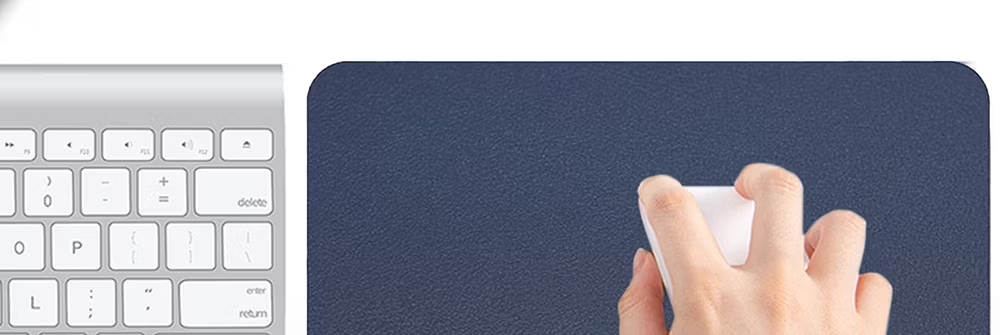
In the modern digital workspace, where professionals spend eight or more hours a day glued to their screens, the tools we use define our productivity and long-term health. While ergonomic chairs and mechanical keyboards dominate the conversation, one critical accessory is often overlooked: the humble mouse pad. Yet, this small surface is the primary interface between a user’s hand and their digital environment.
For B2B sourcing managers, product developers, and brand owners in the tech accessory and office supply sectors, choosing the right material for this interface is paramount. A poor choice leads to user fatigue, inconsistent mouse tracking, and a negative perception of the brand. Conversely, a high-quality material enhances the user experience, boosts productivity, and provides a premium branding opportunity.
At Aybroad, we have analyzed dozens of materials—from traditional fabric-topped rubber to modern aluminum and leather—and the conclusion is clear: **Polyurethane (PU) Foam offers the ultimate combination of performance, comfort, and safety.** In this deep dive, we explore the science behind PU foam mouse pads and why they are the strategic choice for professional environments in 2026.
1. The Anti-Slip Revolution: Unmatched Stability for Precision Work
There is nothing more frustrating for a professional designer, engineer, or data analyst than a mouse pad that slides across the desk during precise movements. This "ghost movement" requires constant micro-adjustments by the user, leading to accelerated wrist fatigue and reduced efficiency.
The "sticky" nature of the PU foam we utilize is not achieved through chemical adhesives, but rather through the micro-structure of the foam itself. Polyurethane is an open-cell or closed-cell structure depending on the formulation, but its base polymer has a naturally high coefficient of friction against smooth surfaces like wood, glass, and laminate.
When placed on a desk, the weight of the user's hand compresses the micro-cells, creating a slight vacuum effect that "locks" the mat in place. Unlike traditional natural rubber bases, which can degrade and lose their grip over time due to oxidation, PU foam maintains its anti-slip properties for years. For B2B buyers, this translates to a product with a longer lifespan and fewer customer complaints regarding performance degradation.
2. The Ergonomic Edge: Variable Density and Micro-Compression Comfort
Wrist pain and Carpal Tunnel Syndrome are significant risks in the modern office. A traditional thin fabric mouse pad provides almost no cushioning, forcing the sensitive median nerve in the wrist to compress against the hard desk surface.
PU foam mouse pads introduce a crucial ergonomic layer. Polyurethane is a viscoelastic material, meaning it possesses both viscous and elastic characteristics. When force is applied, it deforms slowly and returns to its original shape over time (think memory foam, a specific type of PU). This property allows the mouse pad to:
- **Distribute Pressure Evenly:** Instead of focusing pressure on a single point of the wrist, the PU base contours to the unique shape of the user's forearm, distributing the load over a wider area.
- **Absorb Micro-Vibrations:** The rapid, repetitive movements of mousing generate micro-vibrations that travel up the arm, contributing to muscle fatigue. PU foam acts as a high-frequency dampener, absorbing these vibrations before they reach the joint.
- **Provide Consistent Tracking:** While the base cushions the wrist, the surface must remain flat for the optical or laser sensor of the mouse. By using a higher-density formulation of PU, we achieve a surface that is soft to the touch but firm enough to prevent the mouse from "sinking," ensuring pixel-perfect tracking.
3. The Health and Environmental Mandate: The Odorless and Safe Alternative
One of the most common complaints among corporate office managers and individual users regarding traditional rubber-based mouse pads is the overwhelming chemical smell, often referred to as "off-gassing." This odor is caused by Volatile Organic Compounds (VOCs) and sulfur compounds used in the vulcanization process of natural and synthetic rubber. In an enclosed office environment with poor ventilation, these odors are not just unpleasant; they can cause headaches and irritation.
Our PU foam mouse pads are engineered to be **completely odorless**. Polyurethane foam is produced through a precise chemical reaction between polyols and isocyanates. When formulated correctly and cured properly, the resulting polymer is inert and stable. There is no vulcanization process, and therefore, no sulfurous off-gassing.
Furthermore, this stability means PU foam does not harbor bacteria or dust mites as easily as woven fabric tops. It is hypoallergenic and can be easily wiped clean with a damp cloth, a critical feature in the post-pandemic, health-conscious workplace.
4. Customization and Branding: A Strategic Advantage for OEM Partners
For tech brands (Red Wing Saucony level lookalikes in the office space) and corporate sourcing managers, a mouse pad is more than an accessory; it is a prime piece of desk real estate for branding. The material must not only perform but also look premium.
PU foam provides exceptional manufacturing flexibility, allowing for deep customization to align with a brand’s identity or a client’s specific needs:
- **Precise Dimensions:** Whether it’s a standard 200mm x 240mm ergonomic pad or a massive 900mm x 400mm "desk mat" that covers the entire workspace, our precision die-cutting process ensures perfect edges to the millimeter.
- **Variable Thickness:** We can calibrate the thickness of the foam from a ultra-thin 2mm "travel" mat to a plush 6mm "comfort" mat, depending on the target user demographic.
- **Surface Compatibility:** The PU base can be seamlessly bonded with various top surfaces, including smooth polyester for speed mousing, textured surfaces for control, or premium PU leather for executive desk environments.
Conclusion: Investing in Quality that Users Feel
In the competitive landscape of office accessories and B2B tech supplies, differentiation is key. Relying on outdated rubber and fabric combinations results in a commoditized product that competes only on price.
By shifting focus to Polyurethane (PU) foam, you are investing in a superior material science that directly correlates to user comfort, productivity, and safety. A PU mouse pad that is truly non-slip, genuinely ergonomic, and completely odorless is a product that users will appreciate every single day.
For product developers and sourcing managers looking to elevate their accessory line or upgrade their corporate workspace, PU foam is the strategic choice for 2026. At Aybroad, we are ready to help you customize the perfect PU solution for your brand.