 English
  Español
  Português
  日本語
日本語  Français
  繁體中文
繁體中文  简体中文
简体中文 
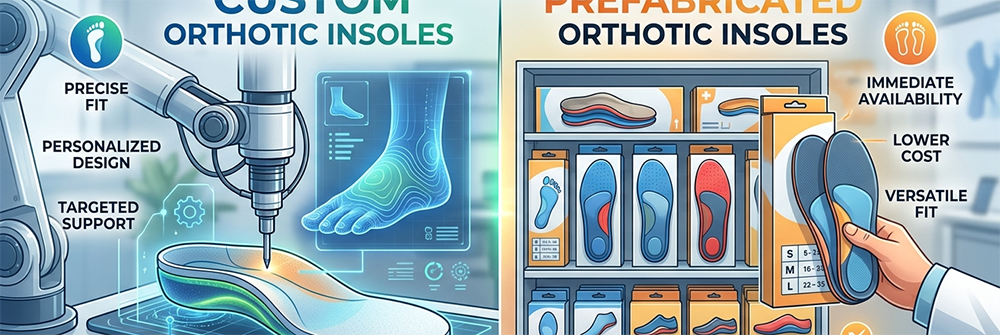
Foot pain, fatigue, and biomechanical imbalances are increasingly common in modern lifestyles. Whether for sports performance, workplace safety, or clinical medical support, orthotic insoles have become an essential solution for improving foot function and reducing skeletal stress.
However, many footwear brands, orthopedic companies, and healthcare distributors face a critical strategic question: Should you invest in fully custom orthotic insoles or scalable prefabricated orthotic insoles?
As a professional custom insole manufacturer and OEM factory, Aybroad helps global brands develop both highly customized and mass-produced orthotic solutions. In this article, we will break down the differences, structural advantages, and strategic applications of each type.
What Are Orthotic Insoles?
Unlike standard cushioning pads, orthotic insoles are biomechanically engineered inserts designed to achieve specific corrective outcomes:
- Arch Support: Stabilizing the medial longitudinal arch to prevent collapse.
- Biomechanical Alignment: Correcting overpronation, supination, and improving gait kinetics.
- Plantar Pressure Redistribution: Shifting load away from pain-sensitive zones or ulcers.
- Shock Diffusion: Mitigating impact forces during walking, running, or long-standing work.
They are universally utilized to treat and manage conditions such as Flat Feet, Plantar Fasciitis, Overpronation, Diabetic Foot Complications, and Chronic Heel Pain.
Understanding Fully Custom Orthotic Insoles
Fully custom orthotics are individual, patient-specific devices fabricated from precise anatomical data of a single user's foot.
The Development Pipeline:
- 3D foot scanning, laser casting, or foam impression molding.
- Dynamic gait analysis and electronic pressure mapping.
- Custom CAD/CAM modeling tailored to specific clinical pathologies.
- Precision CNC milling or advanced 3D printing fabrication.
Key Advantages:
- Anatomical Perfection: Exact contour matching guarantees zero localized pressure peaks.
- Clinical-Grade Correction: Accommodates severe structural issues like leg length discrepancies or rigid flat feet.
- Premium Material Integration: Easily combines specialized medical foams (like Plastazote®), shock-absorbing PORON®, or high-rigidity carbon fiber plates.
Strategic Limitations:
- High Unit Cost: Requires individualized engineering, specialized tooling, and hands-on finishing.
- Extended Turnaround: Longer production cycles make it less viable for fast-moving consumer retail channels.
Understanding Prefabricated Orthotic Insoles
Prefabricated (pre-made) orthotics are mass-produced inserts manufactured in standardized size ranges, engineered around universal, anthropometric foot models.
Key Advantages:
- Economies of Scale: Mass manufacturing via high-speed injection molding or compression molding vastly reduces per-pair tooling and production costs.
- Market Agility & Fast Turnaround: Ready-to-ship inventory enables brands to execute rapid market launches and efficient supply chain replenishment.
- High Consumer Accessibility: Provides sufficient support for mild-to-moderate conditions (e.g., general fatigue, standard arch drop) at an affordable consumer price point.
- Streamlined Private Labeling: Ideal for OEM/ODM private label production, allowing retail brands to easily integrate custom top-cover fabrics, brand logos, and retail packaging.
Strategic Limitations:
- Generalized Geometry: Cannot accommodate asymmetrical foot shapes or specific localized pathologies.
- Support Thresholds: Less effective for severe, chronic biomechanical deformities.
Custom vs. Prefabricated Orthotics: Comparative Analysis
| Feature / Metric | Fully Custom Orthotics | Prefabricated Orthotics |
|---|---|---|
| Anatomical Fit | 100% Personalized to individual foot scan | Standardized based on generic population sizing |
| Arch Precision | Excellent (Adaptive to micro-structural variations) | Moderate (Fixed height curves per size bracket) |
| Medical/Clinical Utility | High (Prescription-grade corrective capacity) | Limited (Focused on prevention and comfort) |
| Production Cost & MOQ | Higher per-unit cost / Low-to-zero MOQ | Low per-unit cost / High manufacturing scalability |
| Lead Time | Longer (Requires individual scanning & design) | Rapid (High-volume continuous output) |
| Primary Distribution Channel | Podiatry Clinics, Medical Labs, Elite Sports Units | E-commerce, Mass Retail, Global Footwear Brands |
The Hybrid Growth Sector: Semi-Custom Orthotic Systems
To bridge the gap between high cost and standardized performance, an increasing number of our B2B clients are adopting Semi-Custom Orthotic Systems. This hybrid approach utilizes:
- A prefabricated, structurally sound supportive base (such as an injection-molded hard TPU chassis).
- A customizable component—either via heat-moldable materials that adapt to the foot under thermal activation, or modular, interchangeable arch pads.
👉 The Business Benefit: It provides your brand with a highly marketable "custom-like" consumer experience while leveraging the rapid scalability and cost structures of prefabricated manufacturing.
Comprehensive OEM/ODM Support from Aybroad
As an established industrial insole factory, Aybroad partners with medical distributors, safety footwear brands, and sports labels to manufacture market-leading orthotics. Our capabilities include:
- Advanced Material Compounding: Sourcing and processing rigid TPU, high-rebound PU foam, shock-absorbing EVA, and medical-grade top covers.
- Precision Mold Tooling: Designing and machining dual-density or multi-density molds for complex prefabricated orthotics.
- Rigorous Prototyping: Delivering physical, functional prototypes within a 3–7 day development cycle for brand verification.
- Turnkey Localization & Logistics: Offering end-to-end multi-lingual private label solutions, customized packaging, and global export infrastructure.
Get Your Custom Orthotic Project Started
Are you looking to expand your footwear line with high-margin orthotic products or scale your clinical inventory?
- Free technical material evaluations available
- 3–7 Day rapid prototyping cycle
- Full OEM/ODM Private Label & Packaging configuration
👉 Contact the Aybroad Engineering Team today to discuss your orthotic project specs.