 English
  Español
  Português
  日本語
日本語  Français
  繁體中文
繁體中文  简体中文
简体中文 
The Mechanical Extremes: A Scientific Approach to Flat Feet and High Arches
The foot arch is nature’s "shock absorber." A healthy arch collapses slightly upon impact to absorb energy and becomes rigid during toe-off to provide propulsion. However, when the arch is too low (Flat Feet) or too high (High Arches), this delicate balance is disrupted, leading to a chain reaction of pain that can travel up to the knees, hips, and spine.
I. Flat Feet (Pes Planus): The Unsupported Chassis
-
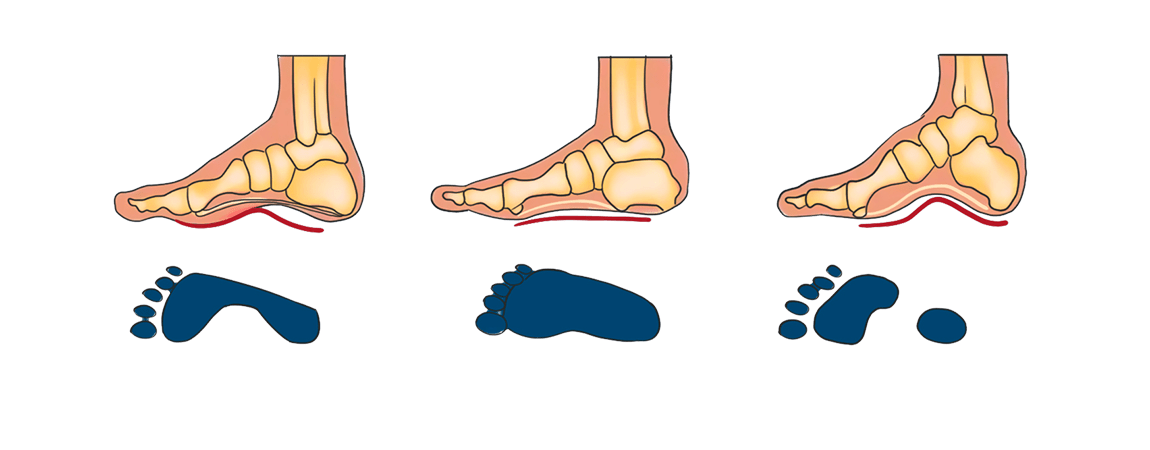
Definition: The arch collapses, causing the entire sole to touch the ground. This is often accompanied by Overpronation (the ankles rolling inward).
-
Impact: Lack of support causes kinetic stress to shift to the knees and hips, frequently resulting in plantar fasciitis, shin splints, and chronic knee pain.
II. High Arches (Pes Cavus): The Failed Suspension
-
Definition: An abnormally high arch that does not descend even under weight-bearing. Pressure is heavily concentrated on the heel and the ball of the foot (metatarsal region).
-
Impact: High arches are too "rigid" and fail to shock-absorb. This leads to frequent ankle sprains, metatarsalgia (forefoot pain), corns, and even vibration-related spinal discomfort.
III. Aybroad’s Counter-Mechanical Solutions
As an insole manufacturer, we apply distinct engineering logics to balance these two extremes:
-
For Flat Feet: Structural Reinforcement & Alignment
-
TPU Longitudinal Arch Support: We utilize high-rigidity materials to physically lift the collapsed medial arch, preventing fascia over-extension.
-
Deep Heel Cup: This feature locks the calcaneus in place, stopping inward ankle rotation and realigning the body’s mechanical axis.
-
-
For High Arches: Total Contact & Shock Diffusion
-
Total Contact Contouring: Rather than a "hard push," our insoles fill the void beneath the arch to increase the surface contact area, effectively redistributing pressure away from the heel and forefoot.
-
Segmented Cushioning: Dual-layer cushioning (such as PORON® or Gel) is integrated into the forefoot and heel to compensate for the arch's natural lack of shock absorption.
-